SiteResolve
From defect report to verified resolution, in one record.
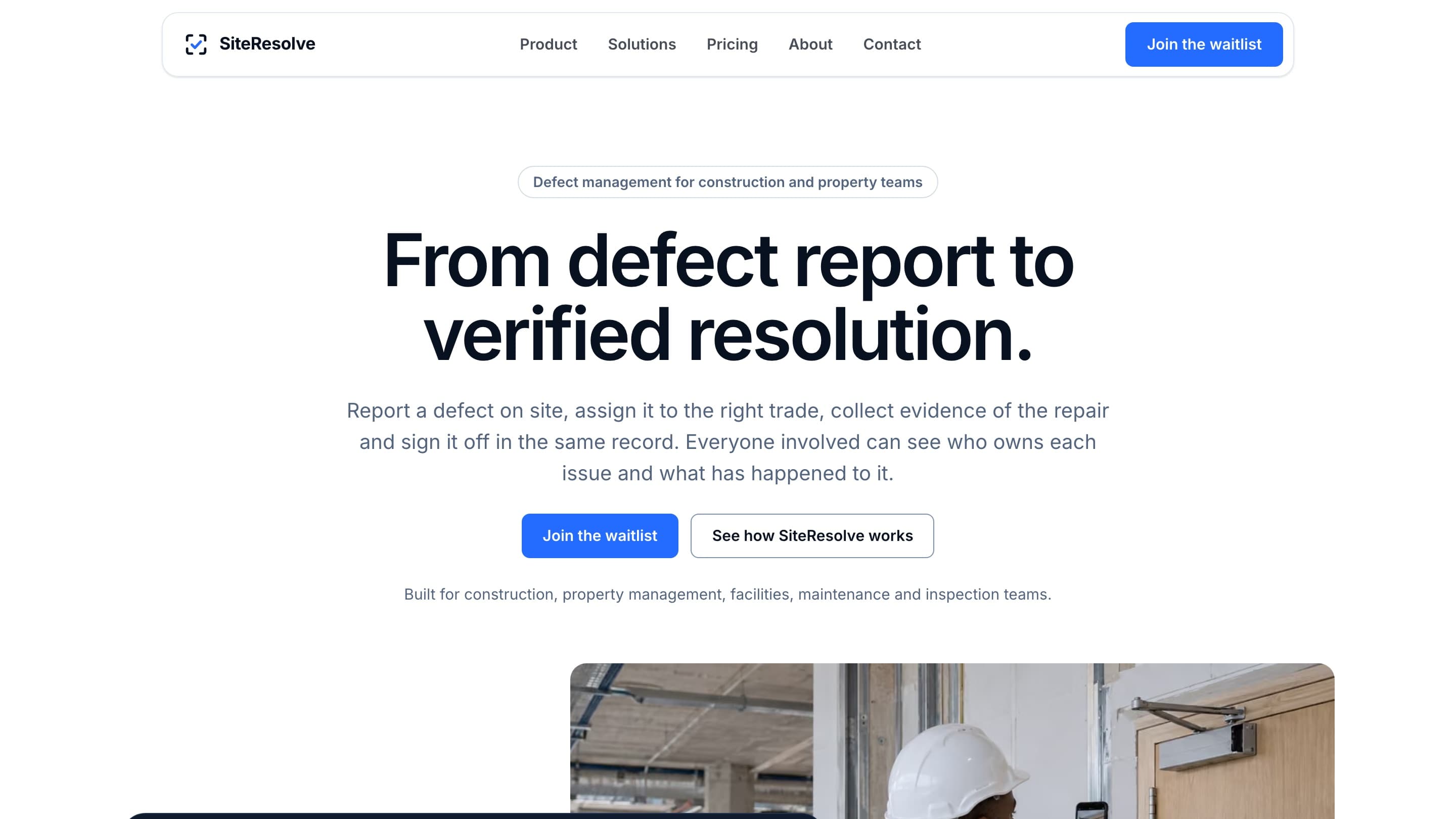
SiteResolve helps construction and property teams report a defect on site, assign it to the right trade, collect evidence of the repair and sign it off, all in the same record.
Visit the product site(opens in a new tab)- Type
- Product Design · Design Engineering · UX/UI
- Role
- Design Engineer / Product Engineer
- Contribution
- Product research · UX/UI · Brand · Engineering
- Year
- 2025
The problem
Defect management breaks down between steps. A defect may begin as a photograph on one phone, become a task in an email and end up as a status in a spreadsheet. The evidence sits in personal camera rolls and chat threads, nobody is named to fix it or given a date, work is marked done without anyone looking at it, and progress reports are pieced together by hand. By handover, nobody can say with confidence who fixed it or whether anyone checked.
What I built
SiteResolve is defect management software for construction, property management, facilities, maintenance and inspection teams. Each defect has one record holding the original report, who owns it, every update, the repair evidence and the final decision, so everyone involved can see who owns each issue and what has happened to it.
Approach
Four steps, one record
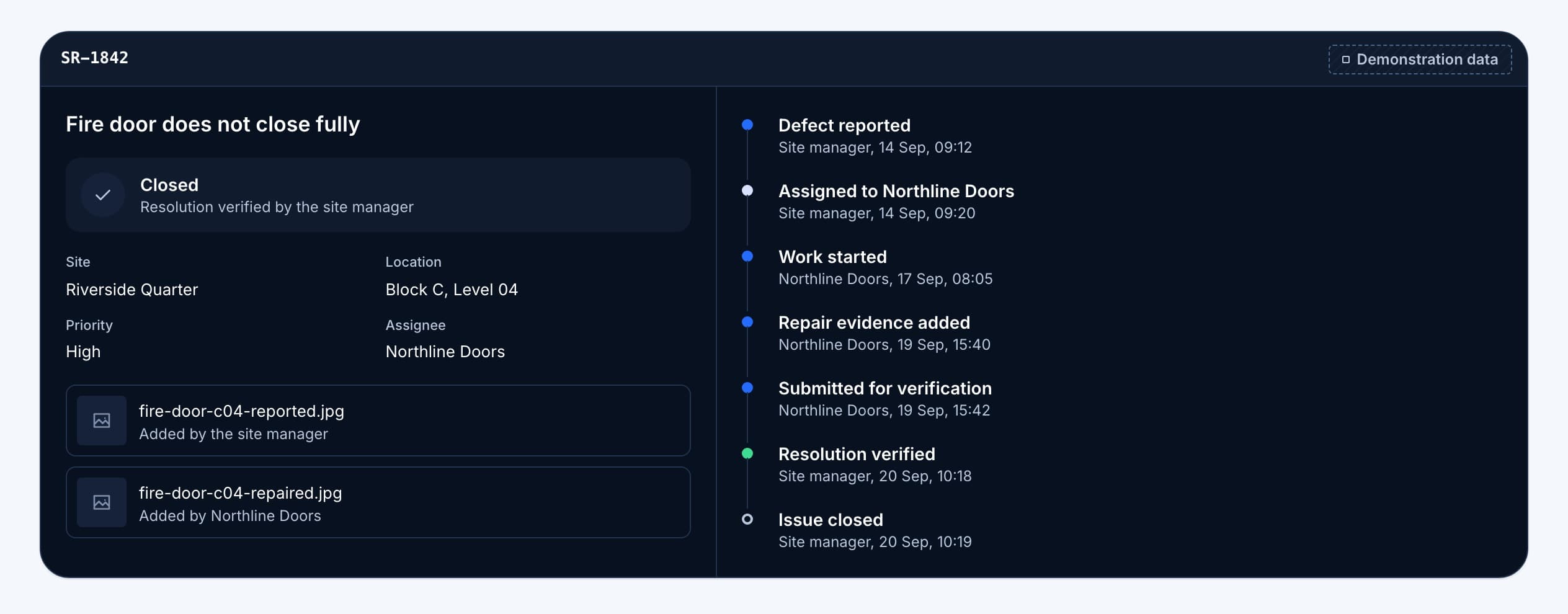
Every defect starts as a structured report and stays in the same record until it is verified and closed. Report records what the person fixing it will need: photographs, the exact location down to the room, category and priority. Assign names an owner, internal or external, with a due date and instructions. Resolve keeps the repair notes and before-and-after evidence beside the original report. Verify puts a reviewer between finished work and a closed issue. Every step is dated and attributed, so the history is the report.
Key decisions
Verification is its own step
Finished work is not approved automatically. A reviewer accepts it, rejects it or returns it for correction, and the decision joins the issue history. ‘Done’ and ‘checked’ are different claims made by different people.
Evidence lives on the issue
Photographs, files, comments and decisions stay attached to the defect they describe, not in a camera roll or a chat thread, so the handover file is assembled from the record rather than re-typed.
Built for the site, not the office
Reporting works on a phone in a basement or on a remote plot. Reports save on the device with no signal and upload when the connection returns.
People see what their role needs
Invited contractors see only the issues assigned to them, and can post updates and upload evidence. Managers get cross-site views of open, overdue and awaiting-verification work.
Engineering
Next.js and TypeScript for the client, with a typed defect schema shared across capture, assignment, resolution and review views. Reports are queued on the device when offline and synchronised when the connection returns. A FastAPI service holds the workflow state, role-based permissions and the dated issue history. AI drafts a defect title and category from the photograph and note, which the reporter edits or discards.
- Client
- Next.js · TypeScript · offline capture
- API
- FastAPI
- Core
- Workflow state · permissions · history
- Assist
- LLM · defect drafting
Outcome
SiteResolve is in development, with a public product site and an open waitlist. The workflow and interface are designed and built against demonstration data, including a worked fire-door scenario traced from report to sign-off. No customer metrics or client names are claimed until there are real ones.
Reflection
Traceability sounds like an admin feature until you watch someone try to prove a defect was fixed. Designing the audit trail as the primary object, rather than a log behind the product, changed the whole information architecture.
- Tools
- Capabilities
Working on something similar?
Start a conversation