Predictive Maintenance for Turbofan Engines
A comparative evaluation of eight AI approaches for predicting the remaining useful life of degrading aircraft turbofan engines using NASA C-MAPSS data.
- Type
- Artificial Intelligence · Predictive Maintenance · Research
- Role
- AI Engineer / Researcher
- Contribution
- Data preparation · Modelling · Evaluation · Research
- Year
- 2026
The problem
Aircraft turbofan engines degrade gradually. Maintenance scheduled too early wastes serviceable life; maintenance scheduled too late risks failure. Remaining useful life (RUL) prediction estimates how many operating cycles an engine has left from its sensor history. Many approaches have been proposed, from classical regression to deep and neuromorphic networks, but they are often reported under different protocols, which makes them hard to compare fairly. This project evaluated eight of them side by side on the same data, splits and test conditions.
What I built
A single experimental pipeline on NASA’s C-MAPSS FD001 dataset, run identically for eight approaches: Ridge Regression, Extra Trees, Histogram Gradient Boosting, a 1D CNN, an LSTM, a Transformer, an Echo State Network and a spiking neural network built as a Liquid State Machine in the NEST simulator.
Sensor readings are prepared once, split by engine and turned into fixed-length windows, so every model sees the same inputs. Each approach is tuned under a controlled evaluation, then scored once on the 100 unseen engines of the official test set, alongside error by degradation stage and computational cost. The spiking model encodes 17 retained sensor features as 34 ON/OFF spike channels, drives a reservoir of 300 leaky integrate-and-fire neurons, and reads out RUL through a ridge regression layer with 301 trainable parameters.
Approach
One protocol, eight models
Key decisions
Split engines, not windows
Windows from the same engine are highly correlated. Splitting by engine rather than by random window keeps an engine’s history out of both sides of the split and prevents leakage.
One protocol for all eight
Every approach receives the same preprocessing, splits and metrics, so differences in the results reflect the models rather than the setup.
Keep the official test set sealed
The 100 NASA test engines are used once, for final evaluation only, so no tuning decision is informed by the numbers being reported.
Read accuracy alongside cost
Models are compared on computational cost as well as RMSE. A slightly less accurate model that is far cheaper to train and run can be the better engineering choice.
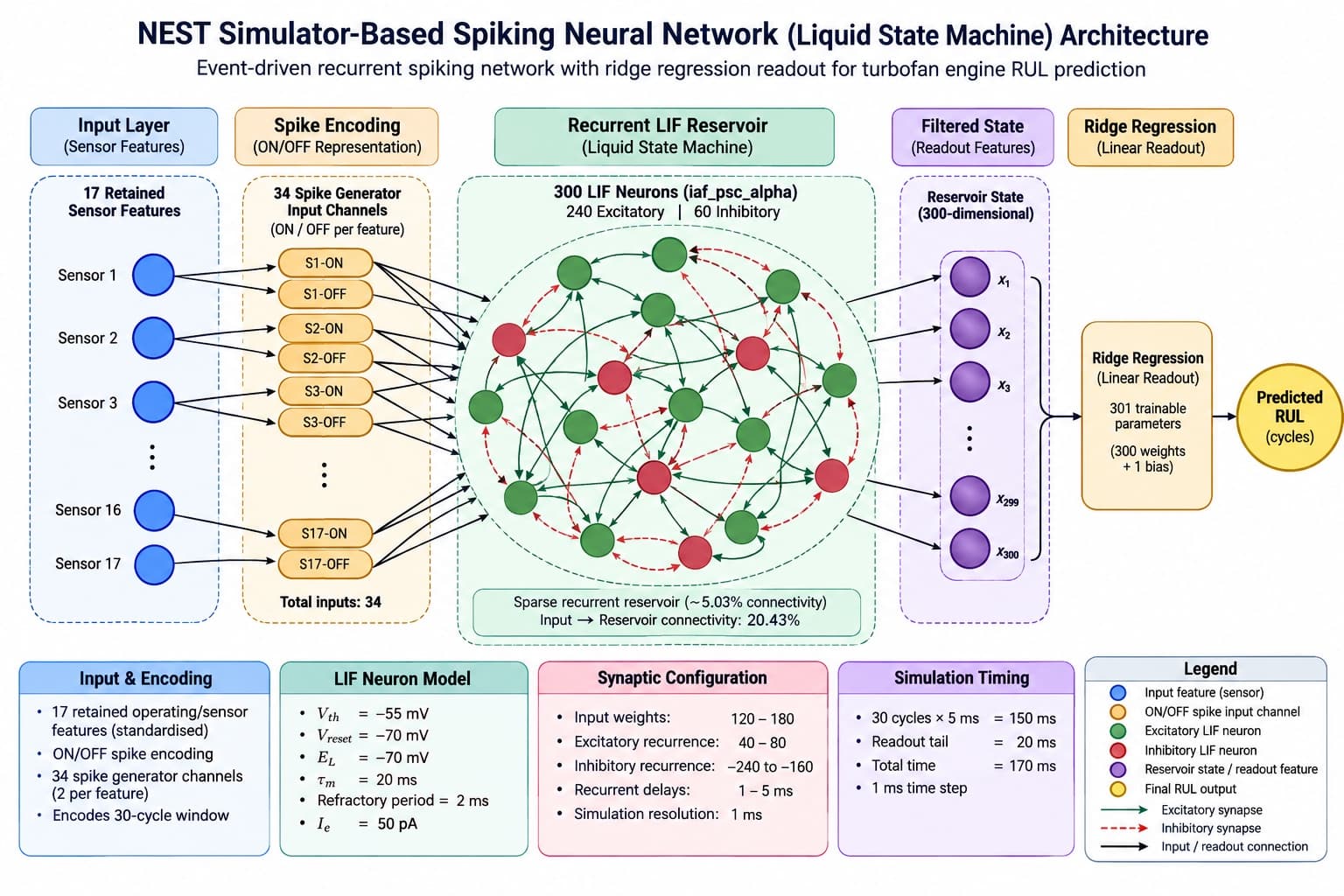
Inside the spiking model
- Input
- 17 sensor features → 34 ON/OFF spike channels
- Reservoir
- 300 LIF neurons · 240 excitatory, 60 inhibitory
- Readout
- Ridge regression · 301 trainable parameters
- Window
- 30 cycles · 1 ms simulation step
Outcome
- Best official-test RMSE (cycles)
- 12.57
- AI approaches evaluated
- 8
- Unseen test engines
- 100
Histogram Gradient Boosting achieved the lowest official-test RMSE at 12.57 cycles, narrowly ahead of the LSTM (12.85) and Extra Trees (12.89). The spiking Liquid State Machine placed last on accuracy at 20.17, but trains only a 301-parameter readout, which is the trade-off the study was designed to expose: accuracy has to be read alongside computational cost.
- Tools
- Capabilities
Working on something similar?
Start a conversation